Pearson Edexcel · A-Level · English Literature
Course version: 9ET0 · Version from Sept 2015
Poetry – Section A: Post-2000 Poetry – Poems of the Decade: An Anthology…
Full specification wording
Component 3: Poetry – Section A: Post-2000 Poetry – Poems of the Decade: An Anthology of the Forward Books of Poetry 2002–2011: A Minor Role U A Fanthorpe
U A Fanthorpe’s ‘A Minor Role’ uses a theatrical extended metaphor to explore the isolating experience of severe illness.
Checked against the Pearson Edexcel 9ET0 specification (opens in a new tab) on .
- Point 9 of 20
- 4 key terms
Study notes
From the checked teaching notes for this specification point.
The idea
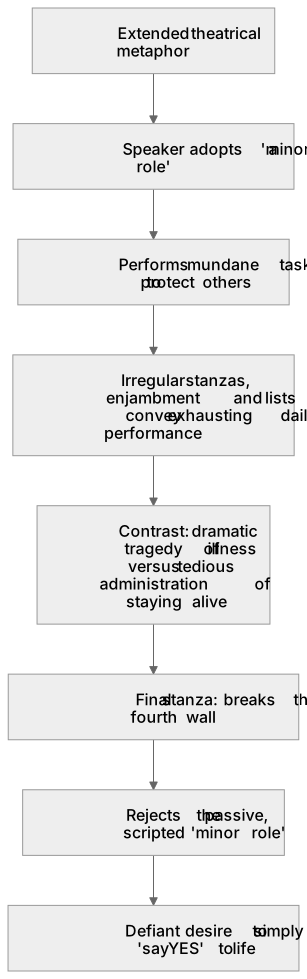
U A Fanthorpe’s ‘A Minor Role’ uses a theatrical extended metaphor to explore the isolating experience of severe illness. The speaker adopts a ‘minor role’ to manage the social expectations of sickness, performing mundane tasks like ‘making endless / enquiring phone calls’ to protect others from the reality of their condition. Fanthorpe employs irregular stanzas, enjambment, and lists to convey the exhausting nature of this daily performance. The poem contrasts the dramatic tragedy of illness with the tedious administration of staying alive. Ultimately, the speaker rejects this passive, scripted existence, breaking the fourth wall in the final stanza to assert a defiant desire to simply ‘say YES’ to life.
What earns the marks
- Analyse the extended theatrical metaphor and how it highlights the performative nature of coping with illness in society.
- Evaluate the use of lists and enjambment to reflect the overwhelming, continuous burden of medical and social administration.
- Discuss the contrast between the internal reality of the speaker's suffering and the external facade they present to friends and medical professionals.
- Examine the tonal shift in the final stanza, where the speaker rejects the 'minor role' and embraces a defiant affirmation of life.
Common mistakes and how to put them right
Interpreting the poem solely as a literal description of acting in a play.
Put it right: Explicitly connect the theatrical terminology to the extended metaphor of living with a chronic or terminal illness.
Overlooking the humour and irony in the poem.
Put it right: Discuss how Fanthorpe uses dry wit and bathos to critique the social awkwardness surrounding serious illness.
Misinterpreting the ending as a resignation to death.
Put it right: Analyse the final line as a powerful, life-affirming rejection of the passive 'sick role'.
Exam tips
- Link the theme of societal expectations and performance to other poems in the anthology, such as 'The Deliverer' or 'Please Hold'.
- Pay close attention to the verbs used in the lists (e.g., 'driving', 'parking', 'holding') to illustrate the exhaustion of the speaker's daily routine.
- Explore how the irregular structure and varied line lengths visually represent the unpredictability and disruption caused by illness.
Try the lesson
The start of the Component 3: Poetry – Section A: Post-2000 Poetry – Poems of the Decade: An Anthology of the Forward Books of Poetry 2002–2011: A Minor Role U A Fanthorpe lesson, made from checked teaching notes for this specification point.
Have a go first
In U. A. Fanthorpe's poem 'A Minor Role', what central metaphor is used to explore the experience of living with a serious illness?
Listen
U A Fanthorpe’s ‘A Minor Role’ uses a theatrical extended metaphor to explore the isolating experience of severe illness. The speaker adopts a ‘minor role’ to manage the social expectations of sickness, performing mundane tasks like ‘making endless / enquiring phone calls’ to protect others from the reality of their condition. Fanthorpe employs irregular stanzas, enjambment, and lists to convey the exhausting nature of this daily performance. The poem contrasts the dramatic tragedy of illness with the tedious administration of staying alive. Ultimately, the speaker rejects this passive, scripted existence, breaking the fourth wall in the final stanza to assert a defiant desire to simply ‘say YES’ to life. A strong answer earns marks for these points. Analyse the extended theatrical metaphor and how it highlights the performative nature of coping with illness in society. Evaluate the use of lists and enjambment to reflect the overwhelming, continuous burden of medical and social administration. Discuss the contrast between the internal reality of the speaker's suffering and the external facade they present to friends and medical professionals. Examine the tonal shift in the final stanza, where the speaker rejects the 'minor role' and embraces a defiant affirmation of life. A common slip: Interpreting the poem solely as a literal description of acting in a play. Instead, Explicitly connect the theatrical terminology to the extended metaphor of living with a chronic or terminal illness. Exam tip: Link the theme of societal expectations and performance to other poems in the anthology, such as 'The Deliverer' or 'Please Hold'.
See it
Put it in order
Put these steps in the order they happen.
- 1. Contrast: dramatic tragedy of illness versus tedious administration of staying alive
- 2. Defiant desire to simply 'say YES' to life
- 3. Final stanza: breaks the fourth wall
- 4. Extended theatrical metaphor
- 5. Speaker adopts a 'minor role'
- 6. Rejects the passive, scripted 'minor role'
- 7. Performs mundane tasks to protect others
- 8. Irregular stanzas, enjambment and lists convey exhausting daily performance
Key words
Say what each word means before you turn the card.
Illness and mortality
Try answering aloud or in your head before turning the card.
Social expectations and performance
Try answering aloud or in your head before turning the card.
Isolation and alienation
Try answering aloud or in your head before turning the card.
The resilience of the human spirit
Try answering aloud or in your head before turning the card.
See every definition
- Illness and mortality
- The isolating experience of severe illness, contrasted with the tedious administration of staying alive.
- Social expectations and performance
- The social expectations of sickness that the speaker manages by adopting a 'minor role' and performing mundane tasks.
- Isolation and alienation
- The isolating experience of severe illness, which the speaker endures while protecting others from the reality of their condition.
- The resilience of the human spirit
- The speaker's rejection of a passive, scripted existence and defiant desire to simply 'say YES' to life.
Label the diagram
Some boxes have lost their names. Pick the right name for each number.
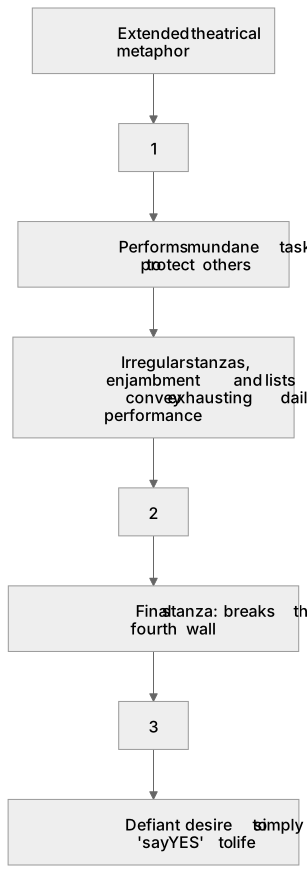
1Box 1
2Box 2
3Box 3
There is more to this lesson
The full lesson goes on to check your understanding and help you earn the marks. Create a free account to carry on, with your progress saved.
A week of Premium from your first lesson · Then the free plan continues · No card, no charge
Test your understanding of Component 3: Poetry – Section A: Post-2000 Poetry – Poems of the Decade: An Anthology of the Forward Books of Poetry 2002–2011: A Minor Role U A Fanthorpe
Active recall beats re-reading. Take an instant quiz now to test what you’ve learned and lock it into long-term memory.
A week of Premium from your first lesson · Then the free plan continues · No card, no charge